


It can be challenging to determine what is influencing Donald Trump one month after the American and Israeli programme of strikes on Iran.
However, it remains apparent he has a keen focus on the oil markets.
A word – or social media post – from the US president regarding his strategies once would spark significant swings in prices, as traders seized upon signals the conflict could worsen or de-escalate.
But in the past few days, investors are showing signs of becoming increasingly doubtful about the impact of his remarks.
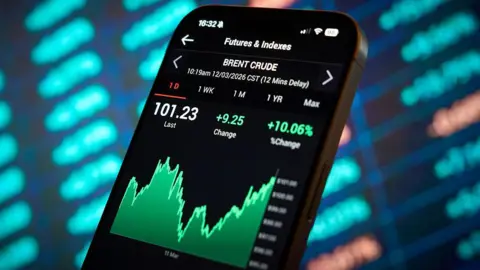
Oil was valued at approximately $72 a barrel (bbl) before 28 February, when the strikes on Iran started.
Recently, it climbed to $118 a barrel on 19 March and as of Friday afternoon was trading at around $112 – substantially up from its pre-war price.
Here are several examples from the last month where Trump and the financial markets appear to have reacted to each other – with mixed results.
Use the navigation button to proceed to the next slide.
"Energy prices have become a proxy for wider geopolitical and economic risks, surging when Trump's rhetoric grows aggressive and falling back when his comments softens," observes one market analyst.
He continues that markets are rightfully sensitive to those signals, due to the big economic risks that are associated with rising oil prices.
"Traders are trying to assess genuine uncertainty," he comments. "Markets can seem jumpy or confused, but what they're really doing is navigating geopolitical risk in the moment, with oil sitting right at the heart of that."
However, it can be challenging for investors to decide how to position themselves, especially since a portion of Trump's remarks appear aimed at affecting oil prices, rather than conveying official strategy, notes another market commentator.
"As the saying goes, the initial victim of conflict is truth," he remarks. "It is likely much of the communication back-and-forth around productive talks, and the opposite, very much are centred around merely moving the price of oil."
Investor Response Become Increasingly Muted
On a recent Thursday, minutes after US equity markets experienced their largest decline since the start of the Iran war, Trump said discussions with Iran were going "quite positively" and he was putting off planned attacks on Iran's energy infrastructure until at least 6 April.
However, the oil price continued to climb.
One market analyst points out that investor responses are "showing less volatility" because of the "huge gap" between Trump's reassurances and the lack of confirmation from Tehran.
"In light of the optics, a large number of market watchers do not foresee an quick conclusion to the conflict and financial markets continue to be anxious."
Another market expert says markets have also adapted to Trump "often altering course at indications of geopolitical, equity market or economic trouble".
"There is a level of doubt, or even outright suspicion, creeping in at the fringes," he adds.


